

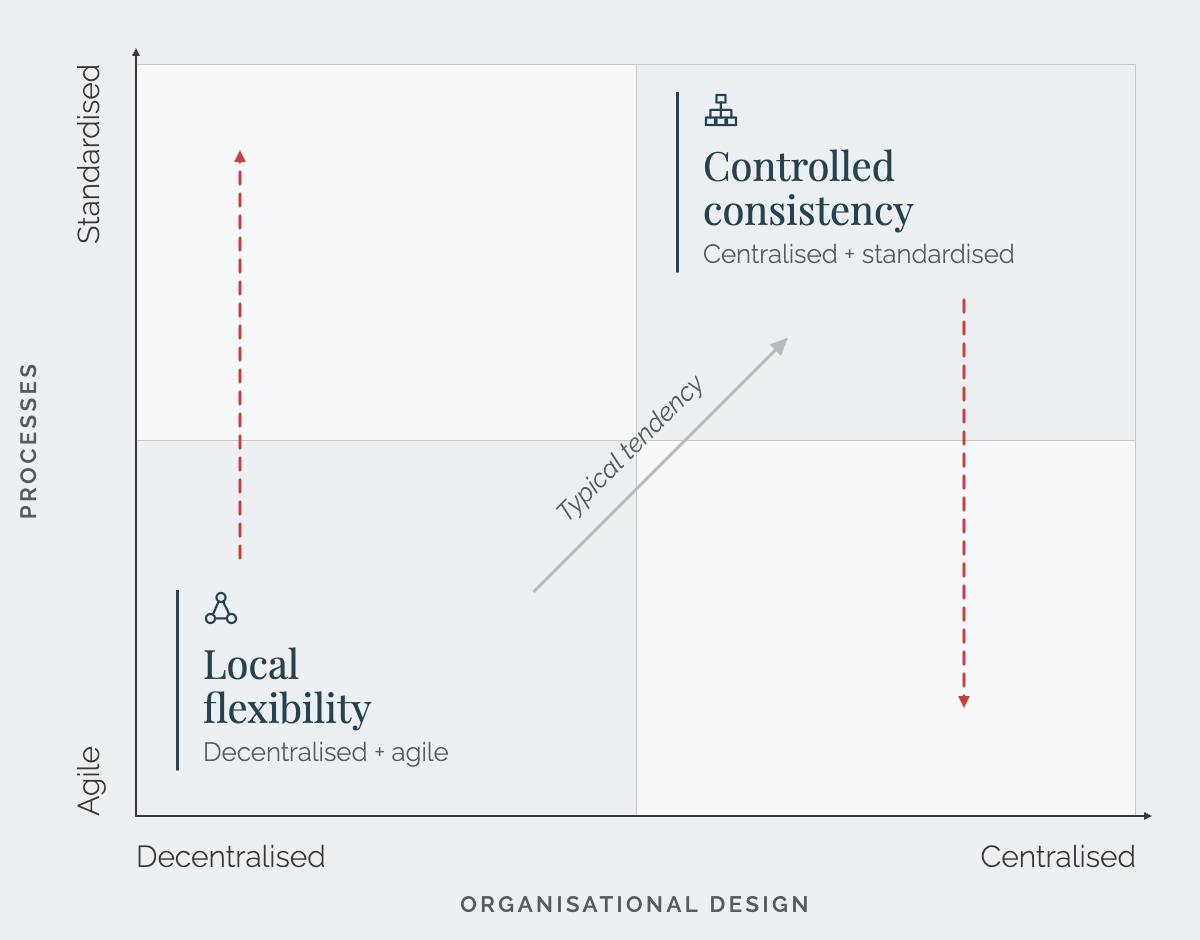
Organisational design and internal processes are closely linked, as the way responsibilities and decision-making authority are distributed across an organisation directly influences how work is performed. In practice, we typically see two organisational archetypes, each characterised by a distinct approach to decision-making and process execution:
- Centralised organisation with standardised processes
Typically, centralised organisational structures facilitate more process standardisation by consolidating ownership, decisions, and execution within one or fewer functions. This makes it easier to establish consistent workflows, reduce variation, and minimise rework and coordination costs. However, standardisation also reduces flexibility, limits responsiveness, and limits the ability to adapt to local needs and changing market conditions.
- Decentralised organisation with agile processes
Traditionally, decentralised structures distribute responsibilities and decision-making authority across individual teams, enabling greater autonomy and agility in responding to specific needs.
Here is the catch. This added level of agility and autonomy can also result in hidden costs that organisations need to be aware of.
In one recent engagement focused on analysing and redesigning an international marketing organisation and its processes, we compared two campaign operating models: one decentralised model that prioritised agility and autonomy, while the other more centralised model relied on earlier commitments and standardised production. In the centralised operating model, clearly defined tasks and earlier commitments enabled production to be planned weeks in advance, supporting more predictable execution and timely delivery of campaign assets. Conversely, the flexible and decentralised model enabled individual adjustments and late changes even after work was considered completed, resulting in less consistent asset visuals and delayed time-to-market.
The commercial dilemma therefore becomes whether the expected benefit of each adjustment justifies its full production cost. The output of our analysis was quite clear. The analysis showcased that production cost, measured by production time per asset, was approximately 2.5 times higher than in the more centralised model, without a significant improvement in the final asset output. This illustrates how a decentralised organisation, combined with flexible production processes can, in some cases, create inefficiencies. In our case, three cost categories were observed in particular: production costs, market impact and employee motivation.
- Production cost
When teams had the autonomy to revisit completed material to accommodate individual preferences for content or format, each adjustment consumed additional production time, but that process also required additional briefing, coordination and approvals. Individually, these changes can appear minor, but collectively, they increase the cost of delivering each output.
- Market impact
Late changes delayed delivery, increasing the time-to-market for the relevant material. Also, added individual and team autonomy weakened consistency across channels. Imagine a kitchen where several chefs prepare the same dish, each following a different recipe and choosing different ingredients. The result? The dish varies every time. Similarly, without shared standards, individual preferences produced fragmented output that weakened brand consistency.
- Employee motivation
For the people involved, repeatedly revisiting completed work or sometimes starting from scratch created frustration as the changes often reflected personal preferences rather than commercial priorities. Over time, this resulted in decreased motivation. This is particularly interesting, as many theoretical papers highlight autonomy as a key driver of motivation. However, this specific example showcases a tension in the relationship between autonomy and motivation. While discretion over one’s own work can strengthen ownership, the freedom to request changes can create repeated rework for others. This undermined the sense of progress and ownership that autonomy is intended to support.
So how do these observations translate into valuable insights? While the identified costs relate to a specific case, I believe the general reflections extend beyond campaign production. In my view, the degree of process flexibility should reflect the nature of the work being performed. Where outputs are repetitive and follow a predefined format, standardisation can improve efficiency without necessarily compromising the quality of the outcome, as was evident in this use case. Conversely, agility should be preserved where creative input and adjustments generate genuine value in the form of asset improvement. Therefore, organisations should assess whether the additional flexibility translates into measurable improvements in outcomes, such as higher customer satisfaction or improved commercial performance, or whether the associated costs outweigh the benefits.
Importantly, this does not require organisations to fundamentally change their structure. Even decentralised organisations can benefit from introducing standardised elements into their processes. In the case described, this could have been as simple as establishing common asset formats while keeping creative freedom over the content visuals. As illustrated in the model, this would allow a decentralised organisation to introduce greater process standardisation without compromising its organisational structure.
Based on our experience, effective organisational design is not about choosing between centralisation and decentralisation, or between agility and standardisation. It is about deliberately aligning organisational structures and processes, preserving flexibility where it creates value and introducing standardisation where it improves efficiency.